Inquire Now
Key Strategic Points
Financial crime compliance with RegTech applies technology to automate and enhance regulation process and is of great value to financial institutions globally. Anti-Money laundering (AML) compliance, Know Your Customer (KYC), Customer Due Diligence (CDD), transaction monitoring, sanctions, PEP (Politically Exposed Persons), adverse media screening, fraud detection and prevention, suspicious activity and regulatory reporting are all platforms and tools found in regtech application. They support banks, fintech firms and insurers and other regulated businesses globally in managing the risk of financial crime efficiently.
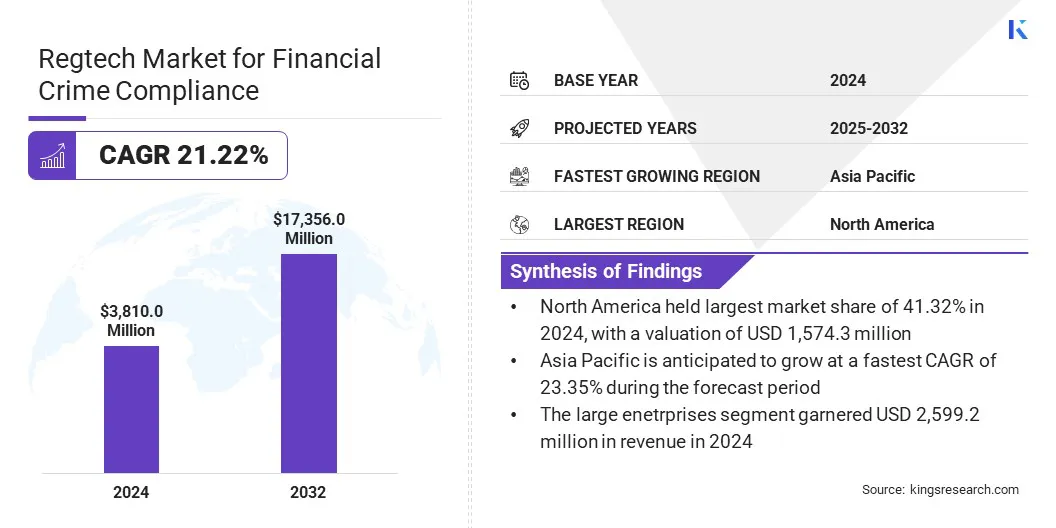
The global regtech market for financial crime compliance size was valued at USD 3,810 million in 2024 and is projected to grow from USD 4,513.6 million in 2025 to USD 17,356 million by 2032, exhibiting a CAGR of 21.22% during the forecast period.
The increasing regulatory complexities and the growing demands of advanced technologies to identify and block financial crimes like money laundering, fraud, and terrorist financing are the factors that have sped up this growth. One key factors is the growing application of artificial intelligence (AI) by governments to advance surveillance and enforcement.
Major companies operating in the regtech industry for financial crime compliance are ComplyAdvantage, Fourthline B.V., Chainalysis, ThetaRay, NiCE Ltd, Trulioo, Elliptic, Hummingbird, Ascent Technologies, Fenergo, Facctum, Youverify, Sumsub, Sanction Scanner, and SEON Technologies Ltd.
Alongside these developments, organizations are increasingly turning to privacy-enhancing technologies (PETs) to maintain data confidentiality while staying compliant with regulatory requirements. Such technological innovations allow more effective, accurate and less expensive compliance solutions to be used, and promotes the wide use among all financial institutions in the world.
Governments have now begun implementing AI systems to identify and address fraud at a national level. This creates a demand signal to the private sector RegTech platforms, which need to be capable of integrating or competing against government-grade analytics.
The Fraud Risk Assessment Accelerator AI tool, developed by the government of the UK, aided in recovering close to USD 566.10 million in fraud losses incurred in 2024-2025 through the identification of suspicious parties and transactions that could not be detected with the traditional systems.
This tool is currently being rolled out by the government. It is not merely typical AI adoption but governments operationalizing AI to work on financial-crime, which sends a strong market signal to financial institutions and RegTech providers. It establishes standards of transparency, scalability and real-time analytics that will be compatible with governmental intelligence systems. This drives up the necessity of advanced RegTech solutions, which are able to be connected to such ecosystems.
Regulatory reversals and uncertainty around the timeline of product development are among the biggest challenges in this market and destabilize the product roadmap of both the buyers and the vendors. In 2024, FinCEN finalized its groundbreaking Investment Adviser AML/CFT Rule, which obliges thousands of SEC-registered advisers to apply AML controls for the first time.
FinCEN delayed the rule to 2028 and reopened it to possible revision in 2025, but vendors were ready to roll it out in 2026. This change places Regtech vendors in a position of waiting to receive payment and delayed buying as buyers freeze decisions. Regulatory whiplash destabilizes predictability of ROI and it further complicates acquisition in new markets.
To address this challenge, Regtech providers are recommended to develop modular and versatile compliance solutions and actively participate in regulation and customer interactions to be able to quickly adapt to changes in the rules or schedule. This flexibility, coupled with scenario planning, is useful in minimizing the effects of the regulatory uncertainty on product development and customer acquisition.
Following the growing data privacy concerns and intricate international laws, Regtech vendors are turning to the implementation of privacy-enhancing technologies (PETs) in the context of financial crime compliance solutions.
According to reports by RUSI (The Royal United Services Institute for Defence and Security Studies), insights identified during a July 2025 roundtable conducted by the Home Office and National Economic Crime Centre underscore the increasing user demand for privacy in response to threats such as targeted hacks, over-mining of data, and the risk posed by totalitarian regimes or criminal groups.
The combination of robust user privacy and law enforcement investigations is already being facilitated by innovative PETs solutions, including ZK Passports, confidential stablecoins and privacy pools.
Nevertheless, the roundtable also highlighted the importance of increased cooperation between regulators, law enforcement and the developers of PETs to ensure that these technologies are created in a way that advances operational goals and compliance goals. With a growing regulatory demand around privacy and transparency, PETs are quickly becoming a major differentiator of a Regtech platform in a privacy-sensitive market.
|
Segmentation |
Details |
|
By Organization |
Large Enterprises, and SMEs |
|
By Deployment |
Cloud, and On-Premise |
|
By Technology |
IA & Machine Learning, Advanced Analytics, Blockchain & DLT, and Specialized Technical Solutions |
|
By Region |
North America: U.S., Canada, Mexico |
|
Europe: France, UK, Spain, Germany, Italy, Russia, Rest of Europe |
|
|
Asia-Pacific: China, Japan, India, Australia, ASEAN, South Korea, Rest of Asia-Pacific |
|
|
Middle East & Africa: Turkey, U.A.E., Saudi Arabia, South Africa, Rest of Middle East & Africa |
|
|
South America: Brazil, Argentina, Rest of South America |
Based on region, the market has been classified into North America, Europe, Asia Pacific, Middle East & Africa, and South America.
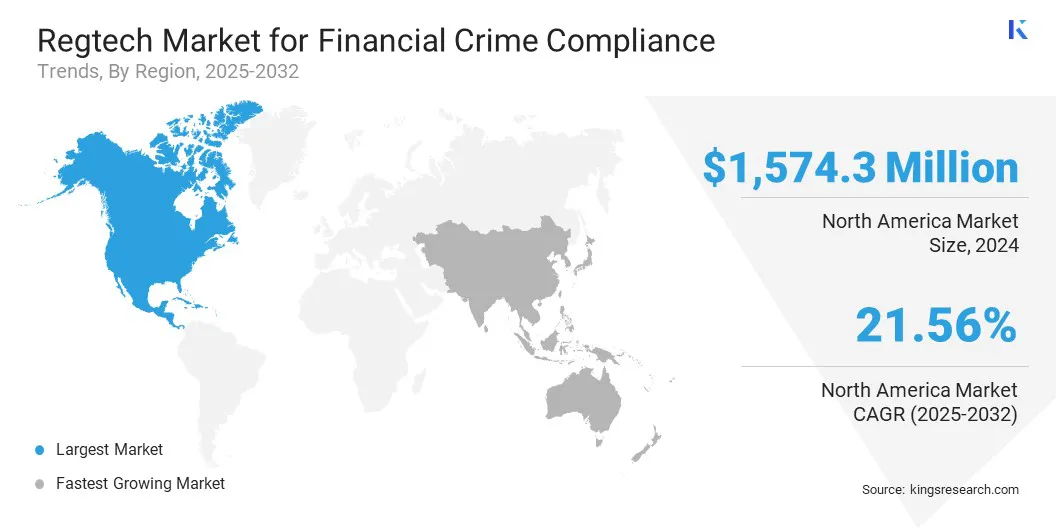
The North America regtech market for financial crime compliance share stood at 41.32% in 2024 and was valued at USD 1,574.3 million. This leadership is due to the region’s well- developed financial base, high level of digital technology adoption, and strict regulations that stimulate the demand for sophisticated compliance solution.
Moreover, the presence of large financial units and the introduction of new innovative technologies like quantum-secure channels give an even greater boost to regional market expansion. The emphasis on operational efficiency and cost minimization in terms of compliance remains a primary driver of the RegTech adoption across a wide range of industries.
Asia Pacific regtech industry for financial crime compliance is set to grow at a CAGR of 23.35% over the forecast period. This strong growth is supported by the high rate of digitization, the growing popularity of fintech and proactive efforts by governments to facilitate regulatory modernization within the region. Countries such as Singapore are fueling the market by imposing stricter regulatory fines and sandboxes to test RegTech.
Moreover, the increasing number of financial transactions, and rising demand in real-time compliance solutions are prompting organizations to move to automated and AI-powered RegTech platforms, aiding regional market expansion.
The major participants in the Regtech market for financial crime compliance are forming partnerships and building new technologies to advance their competitive advantage. To keep up with the constantly evolving nature of the financial criminal and stricter global regulations, vendors are differentiating themselves by installing newer technologies such as AI, machine learning, and real-time analytics. This is particularly evident in transaction monitoring, sanctions screening, and cryptoasset compliance solutions, end-to-end AML solutions, and other specialized solutions.
The market also benefits from strong competition due to the existence of niche startups developing privacy enhancing technologies and blockchain analytics, and larger technology providers that are implementing Regtech solutions as part of the financial services systems.
The landscape is in a continuous state of strategic alliances, acquisitions, and regulatory reforms and businesses are working to offer scalable, inexpensive and customizable compliance services to meet the demands of the traditional financial institutions as well as the fintech innovators.
Frequently Asked Questions

Aswathi holds cross-domain expertise, translating market trends and competitive intelligence into decision-ready insights. Her work helps clients interpret evolving market conditions and identify growth opportunities. She brings a focused, insight-led approach to research execution. She translates these findings into clear, prioritized action plans that align with client capabilities. Her research often includes scenario modeling to test growth strategies under varying economic conditions. She maintains a rigorous validation process, cross-checking primary and secondary sources to ensure reliability. Clients value her ability to synthesize noisy data into concise executive summaries that drive board-level discussions. Her sector-specific lens, combined with a pragmatic focus on execution, consistently delivers high-impact, commercially sound recommendations. Her structured yet flexible research frameworks adapt to client timelines without compromising depth. She is known for distilling complex trade-offs into straightforward, defensible positions that facilitate confident decision-making.
Habi is a seasoned research and consulting leader with renowned experience in guiding clients on strategic growth and transformation initiatives across global markets. He has led high-performing research teams that deliver actionable insights on market expansion, M&A strategies, opportunity assessment, new business development, and product launches. His project portfolio spans large petrochemical producers, electronic device manufacturers, lubricants companies, and other leading enterprises across diverse industrial and consumer sectors. He currently heads the research department at Kings Research, where he is responsible for setting the research agenda, mentoring analysts, and ensuring client-ready deliverables that support executive decision-making. With extensive experience in market intelligence, strategic research, and consulting, Habi brings a strong understanding of evolving industry dynamics, competitive landscapes, emerging opportunities, and business growth challenges. His expertise includes developing research frameworks, translating complex market data into actionable strategic recommendations, and working closely with senior stakeholders to address critical business questions. He has also contributed to building research capabilities, strengthening analytical methodologies, and driving a culture of quality and insight-led decision-making within research teams. His cross-industry exposure enables him to connect market trends with broader business implications and provide perspectives that help organizations identify opportunities, mitigate risks, and make informed strategic decisions.